


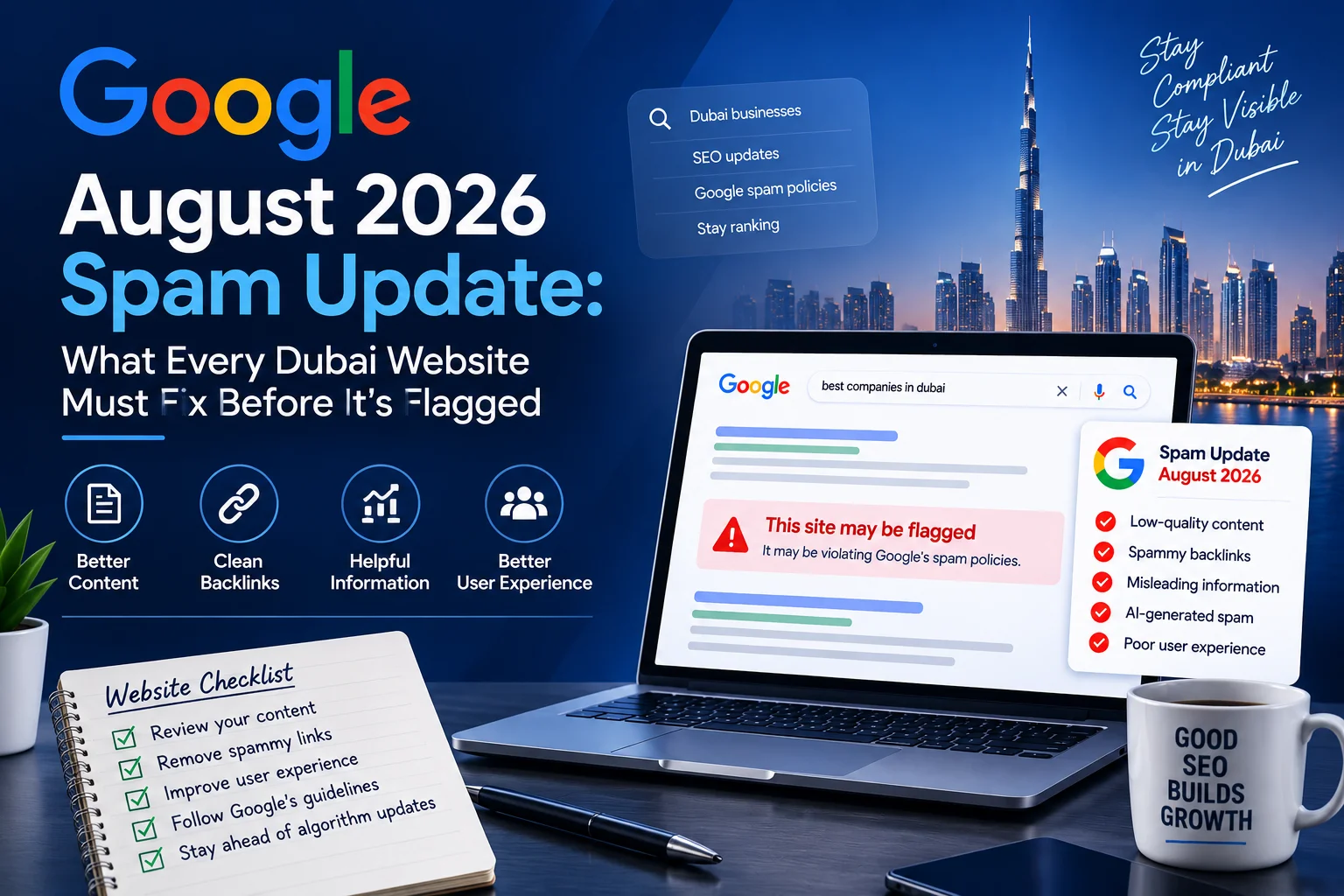


Google closed out August 2026 with a confirmed spam update, and alongside it, tightened how it enforces its site reputation abuse policy in Europe. For UAE businesses that lean on their website for leads, this is not background noise, it’s a direct signal about what kind of content and partnerships now carry ranking risk.
Spam updates don’t get the same headlines as broad core updates, but they tend to hit harder for the businesses they target, because the penalty is often close to a full deindexing of the affected pages rather than a gradual ranking slide. That distinction matters when you’re deciding how urgently to act.
At Zenerom, we treat every confirmed update as a checkpoint, not a panic button. This post breaks down what actually changed, who is most exposed in the Dubai market, and the practical checklist we run for our own clients through our SEO services in Dubai before recommending any changes.
What the August 2026 Spam Update Actually Targets
Google’s spam updates are narrower than core updates. They don’t reassess general content quality across the board, they specifically hunt for manipulative patterns: scaled content abuse, expired-domain abuse, and site reputation abuse (sometimes called ‘parasite SEO’).
The August 2026 rollout leaned heavily on the third category. Google has been increasingly willing to remove or demote pages, even on otherwise trustworthy domains, when those pages exist purely to exploit the host site’s authority rather than serve its actual audience.
Scaled content abuse and expired-domain abuse were also part of the sweep, though less visibly for the UAE market. Scaled content abuse refers to publishing large volumes of low-value pages, often AI-generated with minimal editing, purely to capture search traffic. Expired-domain abuse means buying a domain with existing authority and repurposing it for unrelated content, a tactic that has quietly declined in Dubai over the past year but hasn’t disappeared.
- Third-party content hosted on a domain purely to borrow its ranking power
- Sponsored or ‘guest’ sections with little editorial oversight from the host site
- Pages with no topical connection to the rest of the website
- Content produced primarily to manipulate rankings rather than inform a real reader
Why UAE Businesses Should Pay Attention
Dubai’s SEO market has a well-worn shortcut: renting space on high-authority news, directory, or blog sites to publish sponsored content about unrelated services, real estate, visa consultancy, or business setup pages hosted on domains that have nothing to do with those industries. That shortcut is exactly what this enforcement wave is built to catch.
We’re also seeing more scrutiny across the EU on this pattern, and Google’s enforcement approach tends to globalize once it’s proven out in one region. UAE brands that bought into ‘rented authority’ packages over the past year should assume similar scrutiny is coming here.
There’s also a second-order risk worth naming: if the host site itself gets penalized for hosting this kind of content at scale, every business with a placement there loses that backlink or referral traffic at once, regardless of how well their own site is run. Concentration risk in a link profile is its own liability.
The 5-Point Fix-It Checklist We Run for Clients
If you can’t answer where a backlink or guest post actually lives and why that host site would naturally cover your topic, treat it as a liability, not an asset. Our SEO Site Audit service covers exactly this kind of link and content review, and typically surfaces two or three placements per client that need to be removed or disavowed.
- Audit every backlink and guest placement for topical relevance to the host domain
- Check whether your own site hosts any third-party ‘partner content’ sections unrelated to your core service
- Review any SEO retainer that promises links or posts on ‘DA 50+ sites’ without naming the sites
- Confirm your content has a named author with real credentials, not a generic ‘admin’ byline
- Request a link audit report before renewing any external content or PR package
What to Do If You Think You’ve Been Hit
A sudden, unexplained drop in impressions or rankings right after a confirmed update is the first clue. Check Google Search Console’s Manual Actions report first, most site reputation abuse penalties show up there directly. If nothing appears, compare your top landing pages’ performance before and after the update window to isolate which pages moved.
Recovery from this type of penalty usually means removing or disavowing the offending content or links, not waiting it out. Google has been explicit that these are algorithmic and manual signals working together, so passive waiting rarely resolves site reputation abuse issues.
Once fixes are made, document exactly what was removed and when, this record matters if you need to file a reconsideration request, and it also becomes the baseline your agency should be held to going forward.
Building a Spam-Resilient Content Strategy Going Forward
The businesses that come through spam updates unscathed generally share one habit: they treat every piece of content and every link as something they’d be comfortable explaining to Google directly, in plain language, if asked. If a placement or a tactic only works because nobody looks too closely, it’s not a strategy, it’s exposure with a delay.
We recommend building a quarterly link and content review into your SEO retainer, rather than waiting for a confirmed update to trigger an audit. Spam enforcement in 2026 moves faster than most businesses’ internal review cycles, and catching an issue before an update lands is far cheaper than recovering after one.
How This Fits Into a Broader UAE SEO Strategy
It’s worth stepping back from the update itself and looking at the wider pattern. Every major spam or quality update Google has rolled out over the past two years has pushed in the same direction: reward sites that demonstrate genuine expertise and organic relevance, and progressively squeeze out sites relying on shortcuts. The August 2026 update is one data point in a trend, not an isolated event.
For UAE businesses, this means the smartest response isn’t a one-time cleanup triggered by fear of penalty. It’s treating link acquisition, content production, and technical hygiene as an ongoing discipline that would hold up under scrutiny at any point, not just in the weeks after a confirmed rollout. Businesses that operate this way tend to see updates as non-events, while businesses that have been cutting corners experience them as periodic crises.
If your current SEO provider treats each update as a fire to put out rather than a validation of an already-clean approach, that’s worth examining as closely as the technical issues themselves.
Key Takeaways
- The August 2026 update primarily targets site reputation abuse, unrelated content hosted on trusted domains to borrow ranking power
- UAE businesses using ‘rented authority’ link packages face rising exposure as EU-style enforcement expands globally
- Recovery requires active removal or disavowal of offending content, not passive waiting
- A quarterly link and content audit is cheaper insurance than post-update recovery
ZENEROM’S TAKE
We’d bet this enforcement wave gets stricter before it gets looser. Google has spent two years signaling that domain-level trust is being deliberately decoupled from page-level relevance, and every update since has leaned further in that direction. Our advice to clients: stop asking whether a placement is ‘technically allowed’ and start asking whether you’d be comfortable if Google’s spam team read it themselves.