


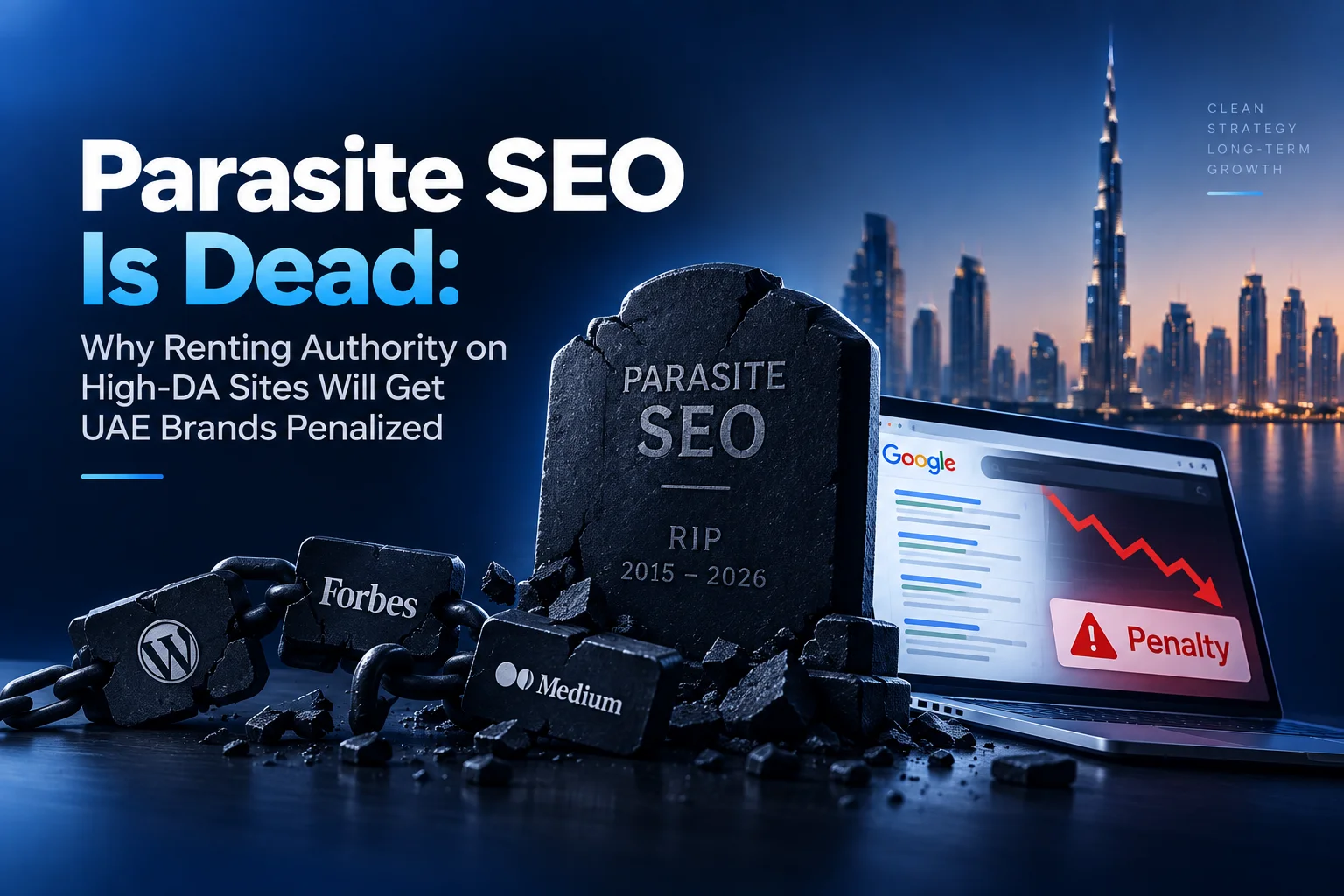



If an agency has ever pitched you a package promising ‘guaranteed placement on a DA 70+ website,’ you’ve been offered parasite SEO, whether or not they called it that. For years this worked. In 2026, it’s actively being dismantled by Google’s own spam enforcement, and UAE brands that still rely on it are sitting on borrowed time.
The term ‘parasite’ is unflattering by design, it describes content that draws its strength entirely from a host it doesn’t belong to, contributing nothing back and often damaging the host’s own credibility in the process. Google’s policy language has caught up with what the industry already called this practice informally for years.
This post explains what parasite SEO actually is, why it’s now treated as a policy violation rather than a clever tactic, and what a safer, durable alternative looks like, the same approach we build into every SEO services engagement at Zenerom.
What Is Parasite SEO, in Plain English
Parasite SEO means publishing content on someone else’s high-authority domain, a well-known news site, an established blog, an old university subdomain, specifically to inherit that domain’s trust and ranking power, rather than because the host site’s audience would naturally want that content.
Classic examples: a payday loan review hosted on a .edu subdomain, an online casino guide published on a respected local news portal, or, closer to home, a visa consultancy’s ‘best business setup services in Dubai’ post appearing on a health or lifestyle blog that has zero editorial connection to immigration law.
In the UAE, this has often taken a slightly different shape: a legitimate local news outlet or lifestyle publication opens a ‘sponsored content’ or ‘partner content’ vertical, sells space in bulk to unrelated advertisers, and applies little to no editorial standard to what goes in it. From the outside it looks like press coverage. Structurally, it’s a link farm wearing a masthead.
Why It Worked, and Why That’s Changing
It worked because Google’s ranking systems historically evaluated domain-level trust more than page-level relevance. A page inherited some of its host domain’s authority almost automatically. Google’s 2026 spam policy expansion closes that loophole directly, treating the practice as site reputation abuse, enforceable independent of whether the content itself is well-written.
In other words: quality no longer excuses the placement. A beautifully written article in the wrong home is still a violation.
This is a meaningful philosophical shift. For most of SEO’s history, the working assumption was that better content always wins. Site reputation abuse enforcement is one of the first policies that explicitly punishes context over craft, where a piece of content sits now matters as much as how well it’s written.
What This Means for Dubai Businesses Buying Content Placements
There’s a budgeting angle here too. Parasite placements are often priced as a flat monthly fee for ‘guaranteed visibility,’ which can look attractive next to the slower, less predictable payoff of genuine PR. But a placement that can be pulled at any time, with no residual value once it’s gone, isn’t really an asset, it’s a rental you’re paying for indefinitely.
- Any ‘guaranteed link on major site X’ offer with no explanation of topical fit is now high-risk, not high-value
- Placements can be removed retroactively, taking your backlink, and any traffic it drove, with them
- Being associated with a flagged host site can create reputational and referral-traffic risk beyond SEO
- Agencies who can’t name the host site up front are usually running a parasite-style network
What to Do Instead
The durable alternative is unglamorous but effective: earn coverage on sites that would plausibly cover you anyway. That means real trade press, local business journalism, genuine partnerships, and PR built around a newsworthy angle, a case study, data you’re willing to share, a founder’s perspective on the UAE market. This is the same principle behind our branding and reputation work for UAE clients.
This approach is slower to show results, typically. A genuine placement earned through a relevant pitch might take weeks of relationship-building rather than a same-week turnaround. But it doesn’t disappear when an editor changes policy, and it doesn’t carry the retroactive risk that comes with rented placements.
- Pitch UAE trade and business publications with a genuine, timely angle, not a disguised ad
- Build relationships with journalists and editors covering your sector, not just link brokers
- Publish original data or research your own audience can cite, this earns links naturally
- Prioritize a handful of relevant, editorially independent placements over volume
How to Vet an Agency’s Link-Building Claims
Before signing any retainer that includes link building or PR placements, ask three direct questions: which specific sites will host the content, why would that site’s own audience want to read it, and can you see an example of a previous placement for an unrelated client. A legitimate agency answers all three without hesitation. An agency running a parasite network will usually deflect at least one.
What Happens to Sites That Ignore This Shift
The businesses slowest to move away from parasite-style placements tend to be the ones who saw the biggest short-term returns from them, which makes the shift genuinely uncomfortable. A brand that built a meaningful share of its backlink profile on rented authority over the past two years can’t simply stop overnight without a plan, that link profile needs to be reviewed, weak placements identified, and a replacement pipeline of genuine coverage built before the old links are cut loose or lost to enforcement.
We generally recommend a phased transition: audit the existing link profile and rank placements by risk, begin genuine PR and content partnerships in parallel rather than waiting for the risky links to be removed first, and only then wind down the highest-risk placements once real alternatives are generating traction. Cutting everything at once, with nothing in the pipeline to replace it, tends to create a visible ranking dip that a phased approach avoids.
Key Takeaways
- Parasite SEO borrows a host domain’s authority without genuine topical fit, and Google now treats it as a policy violation regardless of content quality
- Placements can be pulled retroactively, erasing the backlink and any traffic it generated overnight
- Genuine PR and trade press coverage is slower but durable, and doesn’t carry retroactive risk
- Always ask an agency to name the host site and justify the topical fit before buying a placement